Back to overview
PEAK INSIGHTS
Dreamforce 2026: the work changed, not just the tools
What Salesforce showed in San Francisco, what it opens up at the shelf, how delivery itself is changing, and four bets we are happy to make.

PEAK INSIGHTS
What Salesforce showed in San Francisco, what it opens up at the shelf, how delivery itself is changing, and four bets we are happy to make.
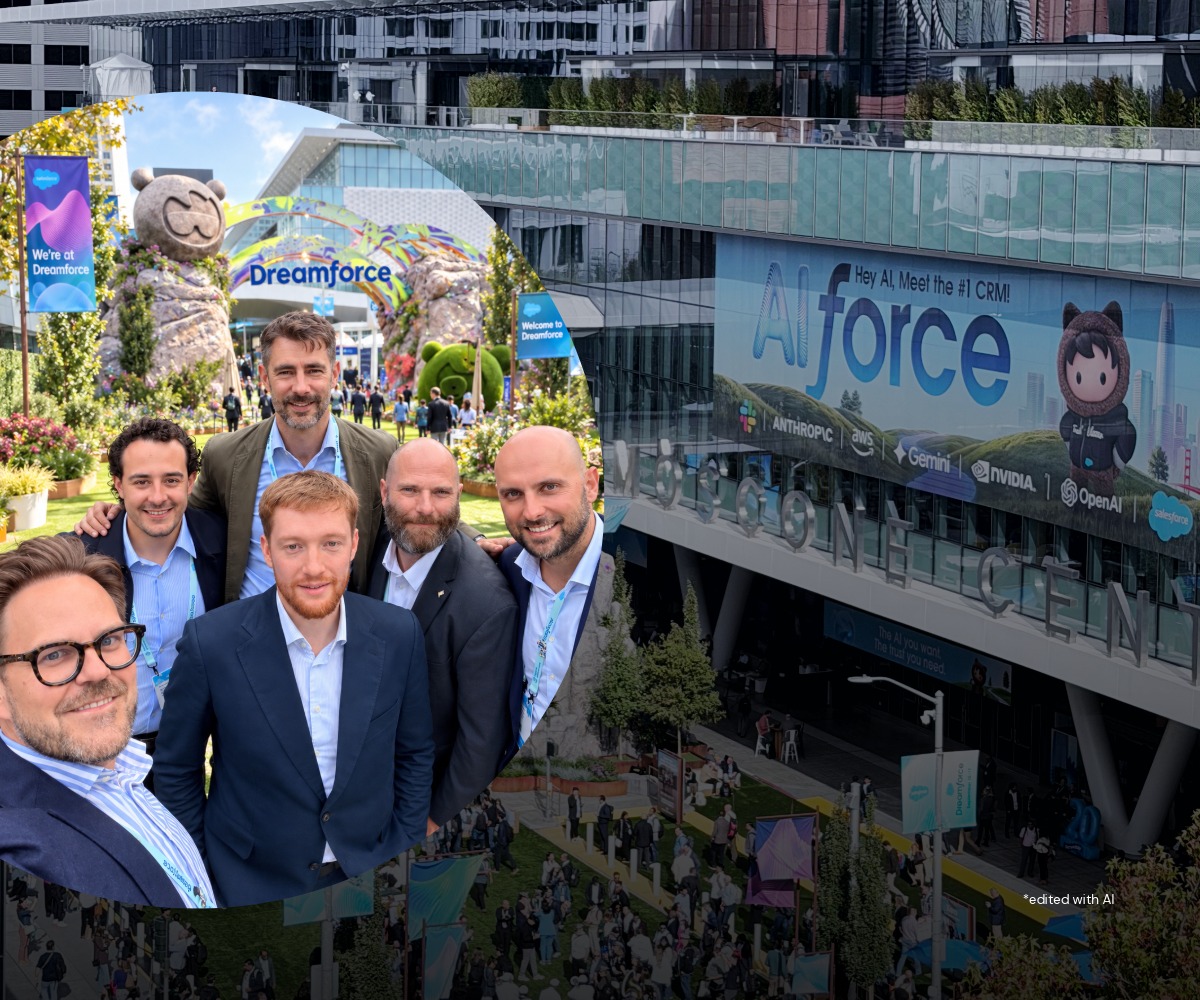
We came back from San Francisco with sore feet and one clear feeling: the way Consumer Goods companies plan, sell and execute is about to get a lot more fluid. Not because of any single announcement, but because three things landed at the same time. The interface is disappearing. The Consumer Goods roadmap finally connects planning to the shelf. And the way software gets built has shrunk from quarters to weeks.
Here is our take on all three, plus four bets we are happy to make for the next 24 months.
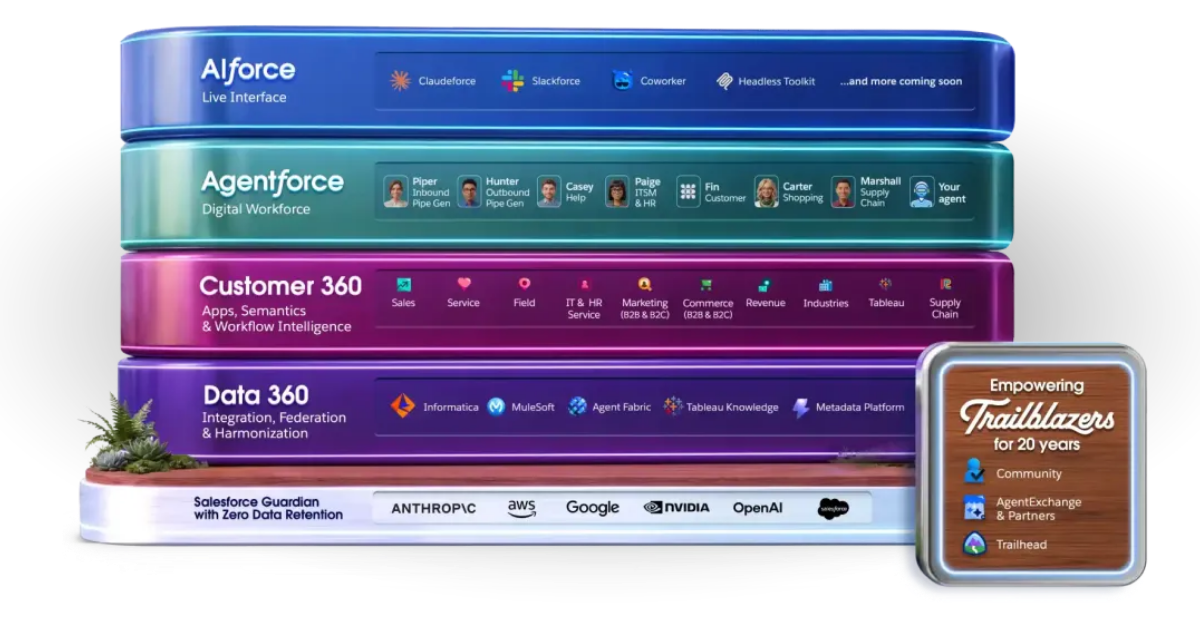
Marc Benioff opened with AIforce, a layer that carries Salesforce data, logic and permissions into Slack, into Claude, into a plain search bar. Nobody in Consumer Goods will mourn the Salesforce tab. A key account manager already lives in Excel, the retailer portal and Teams. If her promotion plan, trade terms and compliance data travel with her into those places, the adoption debate we have had on every project for ten years simply ends.
It also changes what "good data" is worth. When an agent presents your promotion history with total confidence, the companies whose history is clean and whose trade terms are written down get a head start that money cannot buy. That foundation used to be invisible. Now it is the asset.
The Consumer Goods keynote was the most concrete we have seen. Salesforce named four priorities: autonomous planning, distributor management, trade promotion optimization and agentic retail execution, all sitting on one Consumer Goods data model.
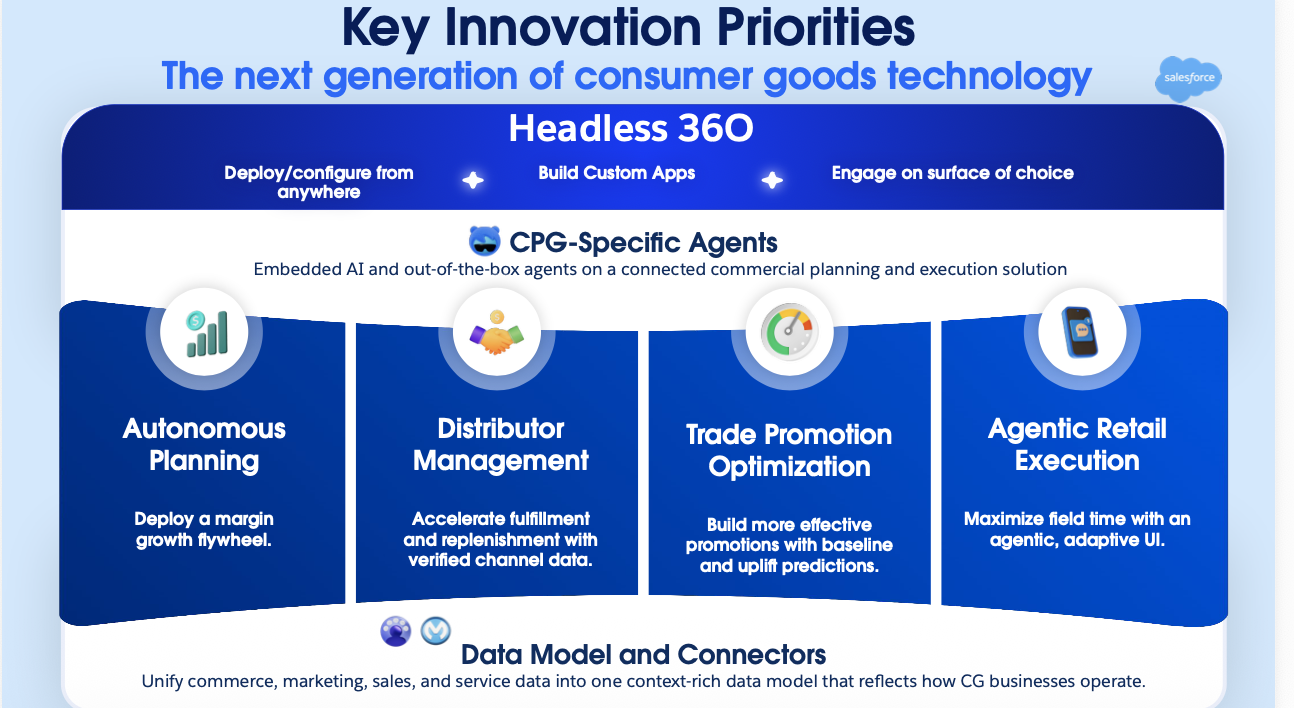 The demo tied them into one story that any FMCG commercial director will recognize. A retailer pulls store openings forward. The sales director raises targets. The key account manager sees it minutes later, checks promo history, compliance and syndicated data in one view, asks the Agentforce Coworker for the best performing promotion and lets an optimization engine improve its ROI within constraints he sets. The plan freezes, and the same context appears on a field rep's phone. Her visit assistant tells her what matters at the next stop. She audits by voice, keys the order by voice, and the visit summary writes itself, offline.
We have built versions of that loop for clients in dairy, beverages and confectionery for years, usually with a lot of glue in between. Watching it run natively, end to end, was the moment of the week for us. And distributor management showing up next to TPM is a signal we take seriously: indirect routes to market are joining the same planning loop as key accounts.
Mars described the enterprise version of the problem in one sentence: they cannot build the same solution 27 times in 27 markets and pay 27 times. Their answer is a lead market, persona-led design and a stated ambition to turn field reps and key account managers from tactical administrators into growth architects. L'Oréal ran its agents in front of employees first, measured them against people, and only then let them face consumers. Nestlé credited a strong digital core for two-week market rollouts.
None of the three started with an agent. They started with the data, the operating model and the people who would use it. That is the order we would recommend to anyone in Consumer Goods, and it is the order we work in.
The session that changed how we think about our own work was not a product demo. Salesforce showed how it builds agents internally: one business owner, one or two builders, daily standups, no requirements document, a working solution in three to six weeks. In one case the builders handed over a model that was 65 percent right and the business owner took it to 80 percent on her own.
This is what AI-native delivery looks like, and it is where Consumer Goods consulting is heading. The long requirements phase is over. A trade marketing manager who wants a promotion compliance agent expects to sit next to the person building it, see a first version inside a week, and shape it in her own language. The consultant's job shifts from writing specifications to bringing category knowledge into the room and getting the data foundation right so the agent has something worth reasoning about.
We have been moving this way ourselves. Our accelerators already carry AI in the build and in the operation, and our teams work as small squads around one commercial question at a time. Dreamforce confirmed the direction and raised the bar on speed. We like that. Fast, close to the business and specific to Consumer Goods is exactly where a specialist partner is at its best.
Four hypotheses, each one falsifiable within 24 months.
The annual trade planning cycle breaks. When baseline and uplift predictions run continuously, "plan in October, negotiate in November, execute all year" loses its logic. Expect rolling promotion plans that re-optimize monthly, and a richer conversation with retailers about what a joint business plan can be.
The field force becomes a growth force. Visit assistants, adaptive interfaces and voice capture take the routine out of the visit. What remains for people is the part that moves volume: the store manager relationship, the new listing, the display that turns a promotion into sell-out.
Retailers get agents too. Within two years the buyer at a major grocer will have an agent reading your proposal before she does. Suppliers whose proposals are structured, consistent and backed by shared data will be the easiest to say yes to.
Distributor sell-out data becomes the new syndicated data. With distributor management on the platform, verified channel data from indirect markets joins the same planning loop as key accounts. Whoever gets there first will have a cost-to-serve view nobody else can match.Watching the sessions yourself
Dreamforce is now on demand, free on Salesforce+. If you only have an hour, these are the sessions we would point a Consumer Goods commercial team to.
Consumer Goods Keynote: Discover the Unified Commercial Hub. The demo we describe above, plus Mars, L'Oréal and Nestlé on stage. Part of the Retail and Consumer Goods series on Salesforce+.
Main Keynote. AIforce, Koa and the interface shift, with leaders from NVIDIA, Anthropic and Siemens. Watch on the Dreamforce page.
Agentforce Keynote: From Fast Start to Real ROI. The most useful session for anyone building a business case for agents in 2027. Dreamforce 2026 on demand.
The biggest opportunity in Consumer Goods right now is not a new tool. It is connecting the promotion data you already have to the field missions you already run, in weeks rather than quarters, with your own people in the room. That is the work we enjoy most, and it is where the returns start.
Dreamforce showed where AI is heading. The harder question is whether Consumer Goods organisations are ready for it.
Our upcoming whitepaper looks at what AI exposes beneath the surface: fragmented tools, disconnected data and slow commercial decisions.
More on that soon.
In the meantime, if you want to take a closer look at your Salesforce or broader commercial ecosystem, get in touch via our website or at info@ppeak.com.


