Back to overview
TPM INSIGHT
Are Your Promotions Running You? Why Salesforce TPM is the Missing Link to Profitable Growth
by Peak & Peak TPM Experts, 2026


TPM INSIGHT
by Peak & Peak TPM Experts, 2026
If this were a movie, it might start like this: A commercial leader sits late at night, buried under spreadsheets that never quite balance. They watch budgets disappear into the void. They thought they were running promotions, but they realized the promotions were running them.
For many in the Consumer Goods (CG) industry, this is not a horror movie script. It is just a normal Tuesday.
In today’s volatile economy, costs are up and consumer loyalty is shifting. Running trade promotions without precision is like gambling. You place your bets and hope the ROI hits. However, hope is not a strategy. To survive and thrive, CG companies must pivot from "gambling" to Revenue Growth Management (RGM).
Here is why Salesforce Trade Promotion Management (TPM) is no longer just an IT upgrade. It is a critical business imperative.
The old way of working involves fragmented spreadsheets, disconnected teams (planning on "backs of cocktail napkins"), and reactive planning. This chaos costs you more than just time. It bleeds revenue.
According to a 2024 Forrester Total Economic Impact™ (TEI) study, legacy environments hinder productivity and drive inconsistent customer experiences. The shift to Salesforce Consumer Goods Cloud flips the script entirely.
The business impact is not theoretical. It is quantified by Forrester’s analysis of a composite organization over a three-year period:
205% ROI: The return on investment is substantial and immediate.
$20.7 Million Net Present Value (NPV): The financial upside is clear.
<6 Months Payback Period: The system pays for itself almost immediately.
$4.8 Million in Incremental Profit: Driven by a 0.5% increase in top-line revenue growth over three years.
When you replace "gut feeling" with data visibility, you do not just stop the bleeding. You start finding growth in white spaces you did not know existed.
Numbers on a page are one thing. Execution in the field is another. Take Coca-Cola Peninsula Beverages (CCPB), an independent bottling company in South Africa that transformed its trade strategy with Salesforce TPM.
Before their transformation, their team faced a common reality:
The "Black Friday" Trap: They were throwing money at discounts to chase volume, only to realize later that the same volume could have been achieved with less spend.
Visibility Gaps: Key Account Managers (KAMs) worked in silos. They lacked a single calendar view of promotions or overlaps.
By implementing Salesforce TPM with advisory and implementation partner Peak & Peak, CCPB moved from chaos to clarity.
Real-Time ROI: Instead of waiting weeks for post-mortems, they can now track P&L and ROI during the planning phase.
Single Source of Truth: A unified calendar allows anyone with access to view promotions across customer groups, eliminating the "spreadsheet shuffle".
Strategic Growth: They are optimizing the "Golden Diamond" of growth—Volume, Revenue, Share, and Transactions.
As Christina Bester, Commercial Process Lead at Coca-Cola Peninsula Beverages, put it: "We didn't just want to digitalize spreadsheets. We wanted to make sure we are fit for future growth".
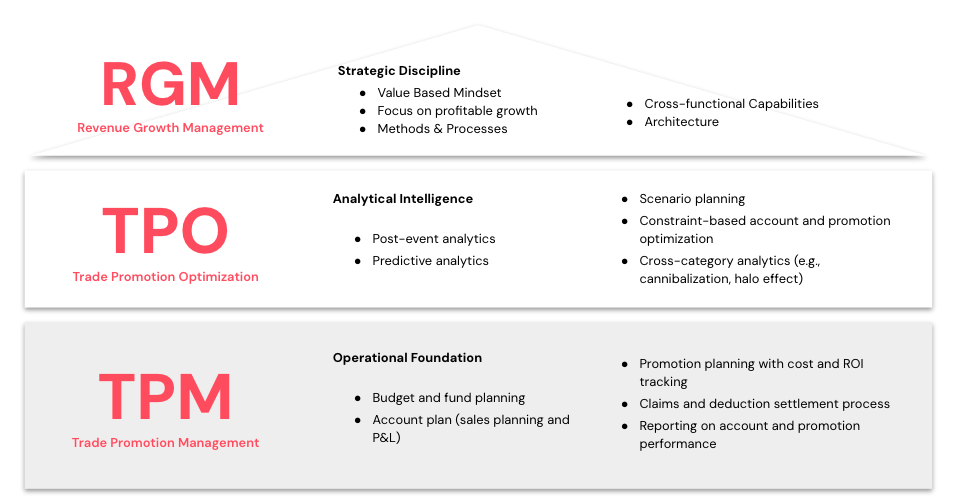
Implementing software will not save you if your process is broken. Success requires a strategic framework. Florian Weimann from Peak & Peak describes this as building a "House of Growth":
The Foundation (TPM): This is the operational layer. It involves getting your trade calendar, budgeting, and claims in order to bring stability.
The Middle Floor (TPO): Trade Promotion Optimization is the analytical layer. You use predictive models and post-event analysis to learn what works.
The Roof (RGM): Revenue Growth Management is the strategic mindset. This is where you define price packs, architecture, and investment rules to drive sustainable profit.
You cannot build the roof without the foundation. Salesforce TPM provides that essential bedrock, turning data into a competitive asset.
The risk of inaction is high. As the market tightens, the companies that can "design" their growth—balancing price, pack, and promotion—will outpace those relying on volume alone.
Forrester's study highlights significant three-year benefits that go beyond simple revenue increases:
$20.8 Million in Productivity: Salesforce saves sales reps 3 hours per week by automating admin and route planning, allowing them to focus on selling
$4.3 Million in Tech Savings: Consolidating legacy systems and point solutions eliminates significant licensing fees and technical debt.
In an economy defined by volatility, precision is your only safety net. Salesforce TPM for Consumer Goods is not just about managing trade. It is about reclaiming control of your P&L. It transforms your commercial team from administrative "gamblers" into strategic architects of growth.
Don't let your promotions run you. It is time to take the wheel.
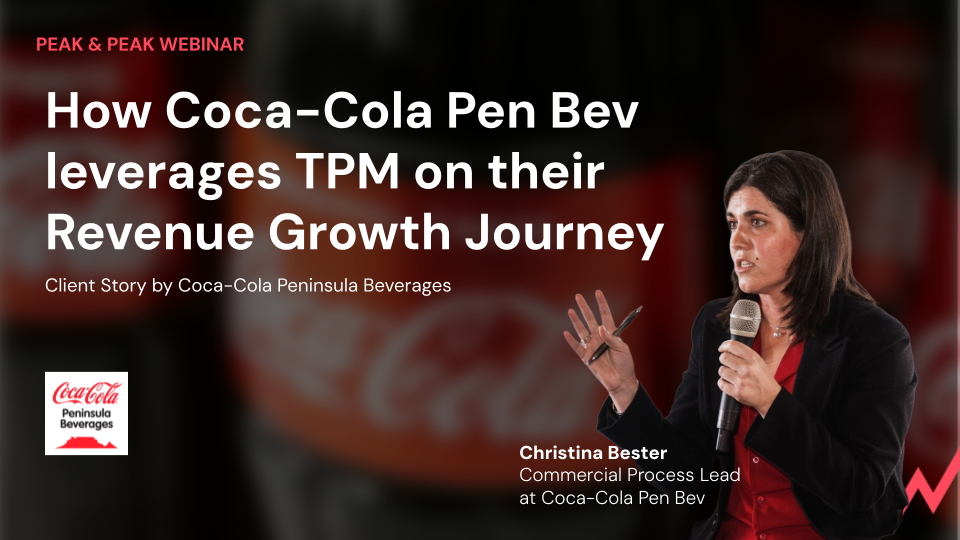
Want to see how Coca-Cola Peninsula Beverages made the shift?
Watch the full story and deep dive into their transformation journey here
Sources:
Forrester, "The Total Economic Impact™ Of Salesforce For Consumer Goods," September 2024.
Peak & Peak x Coca-Cola Peninsula Beverages Webinar Transcript, October 2025.


